The Beginning of the Gospel (Part 2 of 2)
Ministries > Truth For Life with Alistair Begg
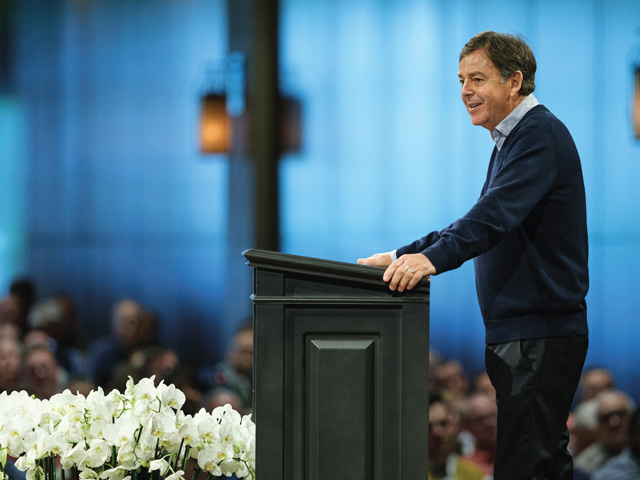
 Did you know that the apostle Mark never actually identifies himself as the author of his Gospel? So how can we be sure he really wrote it? And does this affect the authenticity of his book? Alistair Begg helps us connect the dots on Truth For Life.
-----------------------------------------
• Click here and look for "FROM THE SERMON" to stream or read the full message.
• This program is part of the series A Study in Mark, Volume 1’
• Learn more about our current resource, request your copy with a donation of any amount.
• If you struggle to pray because your mind drifts, you don't know what to say, or you even question if God is listening and able to answer, transform your prayer life by learning to pray like the apostle Paul! ‘Download the free audiobook Pray Big by Alistair Begg.’
Helpful Resources
- Learn about God's salvation plan
- Read our most recent articles
- Subscribe to our daily devotional
Follow Us
YouTube | Instagram | Facebook | X
This listener-funded program features the clear, relevant Bible teaching of Alistair Begg. Today’s program and nearly 3,000 messages can be streamed and shared for free at tfl.org thanks to the generous giving from monthly donors called Truthpartners. Learn more about this Gospel-sharing team or become one today. Thanks for listening to Truth For Life!
Guest (Male): Did you know that Mark, for whom the Gospel of Mark is named, actually never identifies himself as the writer of that gospel? So, how do we know he's really the author? And does that affect the authenticity or reliability of this book? We'll find out today on Truth For Life as Alistair Begg connects the dots for us in the New Testament. Let's open our Bibles to the Gospel of Mark.
Alistair Begg: If you've done history at college, I will be surprised if you have ever been on the receiving end of somebody suggesting to you that we have every reason in the world to doubt the existence of Julius Caesar. It hasn't happened. In fact, they will have affirmed the writings of Julius Caesar without question. The closest manuscript that you can get to Caesar, 850 AD, well, what do we have in relationship to Jesus? Well, we have in Manchester University the John Ryland's Papyru as it's known, because of the archaeological discovery. And that is a fragment of the Gospel of John dated AD 130. So that within a relatively few decades of the passing of Jesus, we have materials that confirm the writings of these gospels. In fact, Robinson, who's a historian at Cambridge, says, the wealth of manuscripts and above all, the narrow interval of time between the writing and the earliest extent copies, make the New Testament by far the best attested text of any ancient writing in the world. By far, the very best attested text of any ancient writing in the world. Now, this is not some Yahoo from T-bread University with a donut sticking out of his ear. This is somebody at arguably one of the most significant universities in the entire world. His academic credibility is such that he's not about to make outlandish statements concerning these things. I don't base my, my convictions on the strength of his affirmation, but I do find it quite encouraging and I hope you do too. But, says somebody, if that is the case, why is it that the New Testament documents are constantly called into question? The Bible outsells every book in the world and continues to do so. The rise of the gospel in South America and in the Southern Hemisphere in general is significant and compelling. Men and women continue to give their lives because they are unprepared to deny the claims of Jesus of Nazareth. And men and women recognizing this peculiar authority which attaches to this book resist it like the plague. And behind that is the activity of the evil one, who in Genesis 3 came as the serpent to Eve, and what was his question to her? Did God really say? Is this, are you gonna base your response, he says to Eve, on a word from God, did God say this? And the evil one from then until now is behind every attempt to undermine, to countermand, to diminish confidence in the verifiability, the accuracy, and the compelling impact of the truth of God's word. And don't let anybody run you off in the coffee shop by telling you about the discrepancies that exist between the manuscripts. One person in a thousand may even know where to find those manuscripts. And if they were to examine them, they would discover that no discrepancy between the manuscripts has to do with the central tenets of the person and work of Jesus. It may say there were three people there, this one says there were two people there. It may say someone was standing up, it may say somebody was sitting down. But the manuscripts do not disagree with one another when they unfold the story of Jesus of Nazareth, Messiah, Son of God, suffering servant, Risen Christ, Returning King. And the reason that people do not want to turn to the Bible is because they are unbelievers. And unbelief is sin. And it is sin which clouds our vision and prevents us from believing the gospel. Now, I take time on that because I think it is absolutely fundamentally important. Because in the thoroughfare of life, in everyday interchange, if you tell somebody for example, tomorrow, that you went to church and they said, and what, what were you studying? He said, well, we started to study the Gospel of Mark. And they say, well, why, why would you even waste your time on that? What are you going to tell them? You're going to tell them, well, in the gospel, I discover that Jesus loves me. In fact, Jesus loves me, this I know, for the Bible tells me so. They say, well, isn't that a children's song? Yes, it is a children's song. But the reason I know is because the Bible tells me so. So this Bible better be a trustworthy, reliable document. Because if I am basing my life, my destiny on who Jesus is and what he's done, and this is where I discover that, this is a fundamental importance. It's not a matter of marginal significance. That's why I take the time on this. Because it is in this book that we discover the wonder of God's love for us in Jesus. It is in this book that we discover our predicament without Jesus. So that's the first thing. Now we're at the second thing and, well, it's questionable whether we'll ever reach the third thing, so just relax. First of all, some general observations concerning the gospels. All right? Secondly, what about Mark as the author of the gospel, what about Mark's gospel? Because if you read the gospel, you will discover that there's nothing in the text which identifies Mark as the author of Mark. So I actually wrote as my heading, number two, my heading was, who wrote Mark? Because he doesn't, you don't go to and he says, hello, my name is Mark and I wrote this. It's not there. You don't have it in the way you have in some of the letters. So why is it that we believe, why is Mark's name appended to this? And has Mark's name always been appended to this particular gospel? Well, in actual fact, the answer to that is, is largely yes. The earliest documents of the church identify John Mark as the writer of this particular gospel. Every gospel, as we said, is based on eyewitness material. And the early writers and the church fathers identify Peter, the Apostle Peter as the source for Mark's gospel. So that Mark has relied most heavily on Peter to provide him with the eyewitness details that have enabled Mark to write this gospel down for the church in his day. After Peter is martyred and gone, Mark remains and Mark writes this material down. Now, if that is accurate, and I want to turn you to just one place. If you turn to Acts and chapter 10. If you turn to Acts chapter 10 and in the account of Peter at the house of Cornelius, we have an illustration of Peter's preaching. And from verse 36, and I can't read it all, but this will just get you started and if you are diligent, then you can follow up on it. This is, this is Peter, uh, preaching. He says, you know the message God sent to the people of Israel, telling the good news of peace through Jesus Christ, who is Lord of all. You know what has happened throughout Judea, beginning in Galilee, after the baptism that John preached, how God anointed Jesus of Nazareth with the Holy Spirit and power, and how he went around doing good and healing all who were under the power of the devil, because God was with him. We are witnesses of everything he did in the country of the Jews and in Jerusalem. And then he goes on to talk about his death and so on. Now, if you just look at that, and then you turn back over to the beginning of Mark's gospel, look at what you discover. You know the message, he says, you know what happened, beginning in Galilee after the baptism that John preached. How does Mark start his gospel? He starts his gospel with the baptism of Jesus in the Jordan by John the Baptist. Now, that would make sense, wouldn't it? If Peter was his eyewitness, uh, and in April, he had to write as he did. Now, you say to me, well, I take your word for it, but I don't know where to find it. Well, I'll tell you where to find it. You want to go to the sources, that's fine. You go and find the bishop from the second century, whose name was Papias, who was the bishop of Hierapolis. He wrote certain things down. Eusebius recorded them for us, and these are extent documents that can be found in libraries. Okay? Here in a big fat New Testament introduction, which most of you are not going to buy and few of you who buy it will ever read it. We have a quote from the aforementioned bishop. This is in the second century. And this is what the bishop says. Mark, indeed, since he was the interpreter of Peter, wrote accurately but not in order, the things either said or done by the Lord, as much as he remembered. For he neither heard the Lord nor followed him. But afterwards, as I have said, heard and followed Peter, who fitted his discourses to the needs of his hearers. Mark, writing some things just as he remembered, erred in nothing. For he was careful of one thing, not to omit anything of the things he had heard, or to falsify anything in them. Okay? So here's the bishop in the church in the second century, and he is writing for the, for the benefit of those who are under his custody, as these men and women are seeking to live for Jesus, as they're being buffeted and as they're being threatened, as all hell is let loose against them in persecution, and as they are turning to the gospel records themselves and they're in need of affirmation, and they are in need of support, they're in need of encouragement, and their dear bishop writes to them and says, when you read the stuff that Mark wrote down for you, you can be sure that although it's not written chronologically, it's all put down there. There's nothing left out that should be in, and there's nothing in that should be out. Indeed, you can trust it in its entirety. And it has been written by this fellow called John Mark. In fact, Mark, if you like, is just what any intelligent Christian should want the earliest evangelist to have been. What do you, what do you, what do you want the person to write the first gospel to be like? Do you want him to be an imaginative creative character? Tempted to flights of fancy? Uh-uh. You want him to be what Mark was. Not an inventor, not a creator, but a conscientious compiler of the information. Not somebody who's sitting around saying, you know, I think if I did this, or I wrote it in that way, or whatever it was. No, this is just, this is a slugger if you like. This is somebody saying, now let me remember again, when Peter came out of there and then he went there, he said, hang on a minute, I'll give you it in just a minute. And then, and then he wrote it down. And under the direction of God the Spirit, you understand the dual authorship of scripture. It is written, Mark's gospel is written by Mark, it is written by God. God breathes out through human instrumentation. And as Mark writes in this way, says the bishop, he does so not on the basis of invention, but on the basis of compilation. And if you think about it, he's only as good as his source. If he is not the source, he's only as good as his source. And what does his source say? When Peter, the source for Mark, writes to the believers in his day in Second Peter 1. Do you remember what he says? We did not follow cleverly invented stories when we told you about the coming and power of Jesus. No. We were eyewitnesses of His majesty. We were there. We were present. We can verify what is written down. That is why we are writing to you as we are. And if you imagine Mark, as it were, in the shadow of Peter by this point in life, saying to himself, this is fantastic. I love this stuff. One day I think I'm going to write some of this stuff down. And if I ever write it down, I'm going to remember what Peter is saying here. No cleverly invented stories, no funny stuff. Eyewitnesses of his majesty. That's how I'll write it down. And every sensible, intelligent Christian recognizes that that is what we want in somebody who's giving us the first gospel. Now, let me set you a little exercise for the uh, the hours of the afternoon or um the hours of the week. And that is, not to play where's Waldo, but to play where's Mark. Where's John Mark? And you can take your Bible, take the Acts of the Apostles, that's the best place to go. And say, now, where do I find this character John Mark? And I'm just going to get you started and then we'll stop. He lived in Jerusalem in a big house. His house was so large that they could have a big prayer meeting in it on the occasion when Peter was put in jail. You remember when the angel comes and liberates him and Peter shows up at the house of someone? He comes knocking on the outside courtyard door, and they've been having a big prayer time to say, get Peter out of jail. Peter comes out of jail, then the lady says, I couldn't possibly be Peter out of jail. Um, which is the, which is just like most prayer times, isn't it? Um, well, that was, that was John Mark's house. It belonged to Mary, that was his mom. He lived there. It is distinctly possible, but a matter of conjecture, that you will find this same house as the location for the gathering of the Last Supper. Possible. And it is distinctly possible that Mark, as is true of certain artists, has painted a little bit of him, albeit a naked little bit of him into his own gospel. What? He painted himself in naked? Yes. Because I think that the character who eludes arrest in Mark chapter 15, by allowing the people to grab his cloak, but not to grab his person, and runs off down the street, starkers. Is probably Mark himself. So you're starting to like him even more, aren't you? He has a cousin who's rich called Barnabas. He has a lot going for him, and with his cousin Barnabas, he goes off with one of Barnabas's buddies, a fellow called Paul, and they go off and they do missionary work. Go find that. Go find where it was. What city was it where he bails out on Paul and Barnabas, and becomes the occasion of disagreement between Paul and Barnabas, so that after that Barnabas goes off in another direction, and Paul goes with Silas. It's all in here. And if you look, you will discover just where it is that we discover that all of this resolves, and Paul writes and he says, I want you to get Mark and bring him to me, because he's so helpful to me in my ministry. Isn't it interesting the kind of people that God uses? You know, if you were thinking of somebody who's going to write, write a, the foundational gospel. Who, who would you go for? Ah, somebody probably Ivy League at least. If not that, we go down a tier, we go to the University of Virginia. They have a good English department, after all, maybe somebody coming out of there. Now, just this character. It's interesting that he would be the follower of Peter as well, isn't it? He who knew what it was to bail out in the face of the challenges of missionary work, probably had his greater sense of empathy for this Peter who bailed out on the face of the challenges in the courtyard of the High Priest. Now, you see, God knows always exactly what he's doing. As he picks up people and puts them in places of usefulness. But the underlying factor was not the peculiar capacity of John Mark, but the underlying factor was the fact that John Mark had encountered the stupendous claims of Jesus, had come to trust in Jesus. His life had been transformed by Jesus. And it was that which caused him to go out and say to people, I have met Jesus. He has changed my life. Would you like to meet Jesus? He will change your life too. And isn't that really all that this adventure is about? Ultimately, at its core, the scattering of this congregation throughout Cleveland and beyond, in the course of the next seven days. Allowing those who have been transformed by the power of Jesus to seize every opportunity to say just that. I met him. He changed me. You too may meet him. He'll change you too. And then we come to the first verse of Mark chapter one. Father, thank you for the Bible. Thank you that while we do not find our confidence in the confirming aspects of archaeology and history and form criticism and documentation. Still, we do well to remind ourselves that alongside and beyond and underpinning all that which we read routinely. There's a vast and compelling compendium which reinforces that to which we give our childlike and often fearful affirmations. Help us then, O God, so to read the Bible and to meet Christ in it, that he might confront us with our need of him, and that we might trust ourselves unreservedly to him. And then help us so to move amongst our friends and neighbors and work associates and family members. So as to tell them this wonderful good news. And may the grace of the Lord Jesus, that same Lord Jesus, and the love of God, our Father, and the fellowship of the Holy Spirit, rest upon and remain with all who believe today and forevermore. Amen.
Guest (Male): You're listening to Truth For Life with Alistair Begg. If like Mark, your life has been transformed by Jesus and you'd like to introduce others to him, we have some resources that are available free or at cost to help you begin those conversations. You can browse our selection at truthforlife.org/evangelism. Two of the most popular evangelistic tools we have are Alistair's booklet titled The Man On The Middle Cross and a gospel tract titled Ever Wonder Why Your World Feels Broken? Both of these were adapted from Alistair's teaching. They're easy to keep on hand for when God opens the door for gospel opportunities. You can buy them bundled together for just a dollar and 20 cents. Purchase your supply online at truthforlife.org/evangelism or call us at 888-588-7884. And if you add a donation to your purchase, be sure to ask for Alistair's brand new book We Will Be Changed. The book is our way of saying thanks for supporting this ministry. We will be changed offers insights into the description of the fruit of the Spirit found in Galatians chapter 5. And you may be familiar with these qualities listed in the passage, but have you ever wondered how the virtues like love and joy and peace and patience actually take root in our lives? That's the focus of Alistair's teaching in this short book. You'll learn important lessons like how to embrace the joy of your salvation, how God uses trials to grow our patience. Most of all, this book shows that God is at work cultivating real Christian character in us. Character that will influence those around us. Ask for your copy of We Will Be Changed when you donate to support the ministry of Truth For Life today. Go to truthforlife.org/donate. Or if you'd rather mail your donation along with your request for the book, write to us at Truth For Life, PO Box 398000, Cleveland, Ohio, 44139. I'm Bob Lapine. Thanks for listening. As we are finding out, the Bible is no ordinary book. Not only does it continue to outsell every other book in the world, tomorrow we'll find out why it's unlike any other book that's ever been written or ever will be written. The Bible teaching of Alistair Begg is furnished by Truth For Life, where the learning is for living.
Related Episodes
A Man with a Message (Part 1 of 2)
Thursday, September 10
The Beginning of the Gospel (Part 1 of 2)
Tuesday, September 8
The Coming of the Lord (Part 6 of 6)
Monday, September 7
About Truth For Life
Truth For Life distributes the unique, expositional Bible teaching of Alistair Begg. Studying God’s Word each day, verse by verse, is the hallmark of this ministry. In a desire to share the good news of the Gospel without cost as a barrier, the entire teaching archive is available for free download and resources are available at cost with no markup.
About Alistair Begg
Alistair Begg has been in pastoral ministry since 1975. Following graduation from The London School of Theology, he served eight years in Scotland at both Charlotte Chapel in Edinburgh and Hamilton Baptist Church. In 1983, he became the senior pastor at Parkside Church near Cleveland, Ohio. He has written several books and is heard daily and weekly on the radio program, Truth For Life. The teaching on Truth For Life stems from the week by week Bible teaching at Parkside Church. He and his wife, Susan, were married in 1975 and they have three grown children.Contact Truth For Life with Alistair Begg
Website
http://www.truthforlife.org/?utm_source=oneplace&utm_medium=sitelinks&utm_campaign=home
Mailing Address
Truth For Life
P.O. Box 398000
Cleveland OH 44139
Telephone (Customer Service)
888-588-7884 Domestic
400-543-6800 International
440-543-0522 ( Fax)


