Pleasing God
Ministries > Truth For Life with Alistair Begg
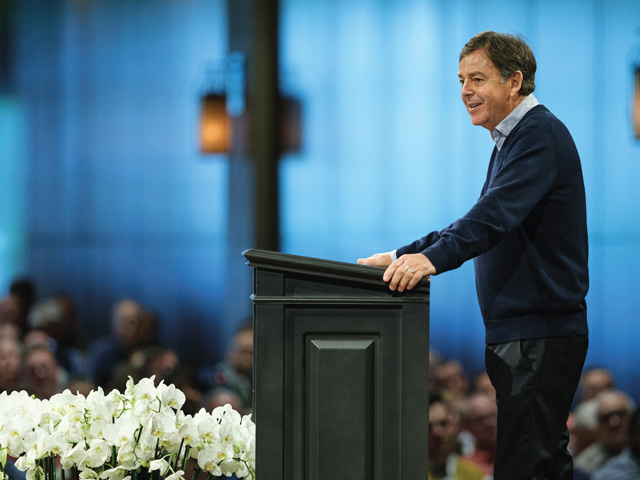
 Throughout history, people have tried to predict Christ’s second coming—but Scripture is clear that no one knows the day or time. So how are believers to live until Jesus returns? Study along as we explore the answer on Truth For Life with Alistair Begg.
-----------------------------------------
• Click here and look for "FROM THE SERMON" to stream or read the full message.
• This program is part of the series A Study in 1 Thessalonians, Volume 2’
• Learn more about our current resource, request your copy with a donation of any amount.
• FREE AUDIOBOOK! In our polarized culture, disagreement is often seen as combative and offensive. What if there were a way to do it well? Download your free copy of The Art of Disagreeing by Gavin Ortlund and master how to disagree with kindness and influence. Request yours at ‘truthforlife.org/disagree.’
Helpful Resources
- Learn about God's salvation plan
- Read our most recent articles
- Subscribe to our daily devotional
Follow Us
YouTube | Instagram | Facebook | X
This listener-funded program features the clear, relevant Bible teaching of Alistair Begg. Today’s program and nearly 3,000 messages can be streamed and shared for free at tfl.org thanks to the generous giving from monthly donors called Truthpartners. Learn more about this Gospel-sharing team or become one today. Thanks for listening to Truth For Life!
Guest (Male): All through history, various individuals have attempted to predict the return of Christ, His second coming. The Bible is clear though, that no one knows the day or the time. So how are we as Christians to live in the interim until Jesus returns? Today on Truth For Life, Alistair Begg begins a study in 1 Thessalonians chapter 4 where the Apostle Paul answers that very question for the Thessalonian believers.
Alistair Begg: In my experience in the last little while, most of the time that I've heard the word piety used, it has been used within the context of disdain. It has been used in a way that suggests piety is a form of withdrawal from society and usefulness, and indeed, it has become almost a figure of fun amongst people that we might expect would hold it differently. It is therefore of some import that when we turn to the opening verses of 1 Thessalonians 4, we discover that what Paul is addressing is this whole question of piety. The whole emphasis in Paul's final two chapters here of 1 Thessalonians is on the matter of ethics, on the extreme practicality of what it means to live as a practical, biblical, vibrant, and attractive Christian. Sadly, one of the features of contemporary Christianity is that Jewish families have a better standard of living when it comes to fulfilling marriage vows, effective child-rearing, and the abiding by principles of the law. I say that not by conjecture, but those are actually the findings as a result of research in relationship to religious heritage. There is an obvious reason for that, and it is this: Jewish people have no problem, at least in orthodoxy, recognizing that God has standards. They have been trained from their earliest days to know that God has given a law and that God has given the law not to be toyed with, but to be adhered to. Consequently, if they are going to live in obedience to that law, then it is going to make an impact on their lives. Christians in the last 50 years have been so concerned to make it clear to everyone that we are not under the law that they have virtually vetoed the idea of the law of God altogether. This accounts for the confusion that is represented in so many lives and in so many families and indeed in so many churches. While we understand that the believer no longer keeps the law as a means of acceptance with God, the fact of the matter is that we are still under obligation to keep God's moral laws and His commandments. That frankly is a sentence that will do well to be pondered by many of us. Throughout all of Scripture, we have a call to this biblical standard. As we're going to discover, Paul is intensely practical concerning this matter of pleasing God. He says, "I want to explain to you what pleasing God means when you think about the whole question of sex." And that is not for this evening. "I want to tell you what pleasing God means when you think about the whole question of work. And I want to tell you what pleasing God means when you deal with the matter of bereavement." There's not a man or a woman living who does not have an interest in, a concern about, a perspective on the issues of sex, work, and the death of oneself or a loved one. If we are going to declare that we have been brought to a new life in the Lord Jesus Christ, then the world has every right to look and see a new lifestyle. There would be that dimension to us which is holy, which is bent on pleasing God. Despite the fact that the Bible has a tremendous amount to say about pleasing God, I haven't actually read a great deal or seen a great deal written or addressed on the subject of what it means to please God. And yet Paul is suggesting here, indeed declaring here, that pleasing God is the guiding principle of balanced Christian behavior. It was indeed the very example of the Lord Jesus Himself, who in John 8 declared, "I always do what pleases my Father." This guiding principle of pleasing God is, says John Stott very helpfully, three things. It is a radical principle because it forces me to recognize that I cannot say that I love Him and that I know Him if I do not seek to please Him. It forces me to ask the question: Whom am I trying to please? When I walk into the study or the office tomorrow morning, whom am I trying to please? We're probably trying to please a number of people. When we go into the schoolroom, whom are we trying to please? At the very foundation of it all, and indeed at the capstone of it all, should be for the believer an overarching commitment to please God. It is a radical principle. It is also a flexible principle in so far as it saves us from Pharisaism and from legalism. It saves us from a big long list of dos and don'ts because the emphasis is not on keeping the law, but on pleasing the Lawgiver. It is very possible for us to create a long list of things that we either do or we don't do in which there is no pleasure, there is just carping subservience. But when we abide by the principle of saying, "I want to please the one who gave the law," then it follows that we'll do what His law says. Our emphasis is, "I want to do what pleases Him. I want to discover it, and then I want to do it." It is also, as a guiding principle, something that is progressive in so far as we can spend all of our lives with this as our overarching emphasis and never reach the fulfillment of it. If tonight we affirm again our desire to please God and to do it more and more, we'll be back next Sunday still with the same overarching desire, perhaps a little closer, but definitely not there. Indeed, we may live all of our lives with this as the guiding principle of our behavior. I want to turn with you to Colossians chapter 1, and I want to answer the question: What does it mean to please God from Paul's prayer for the Colossians? Interestingly, in Ephesians 5 and in verse 10, Paul says to the Ephesians, "I want you to find out what pleases the Lord." That in fact is a great quest for our lives. There are a number of places to which we might go to answer that question. Indeed, the whole of the New Testament helps us to answer the question, and the subsequent verses here in 1 Thessalonians will do the same. In order to give us a starter on it, I want to just draw your attention to these four things which Paul prays for the Colossian Christians and which help us to answer the question: What then does it mean to please God? What pleases God? First of all, fruitful living pleases God. Verse 10 of Colossians 1, "And we pray this," says Paul, "in order that you may live a life worthy of the Lord and may please him in every way: bearing fruit in every good work." Bearing fruit in every good work. Having been placed in Christ, what the New Testament says to us is this: all of our days and all of our deeds are to be good for something and they are to be good for someone. When a man or a woman sets themselves to the quest of finding out what pleases God, seeking to live in a way which brings pleasure to Him, one of the things that becomes immediately apparent is that fruitful living which produces good work is one of the ways in which God is pleased with us. There is a dependence which is necessary for fruitfulness to be affected. You may remember Jesus, in one of His pictures as He gives it to His followers concerning the story of the vine and the branches, He says to them in John 15, "I am the true vine and my Father is the gardener. He cuts off every branch in me that bears no fruit, while every branch that does bear fruit he prunes so that it will be even more fruitful. No branch can bear fruit by itself; it must remain in the vine. Neither can you bear fruit unless you remain in me." The simple truth is this for us to face this evening: there is a dependence which fruitfulness displays. The individual who has set themselves to the task of pleasing God will be surprised by fruitfulness in our lives. Indeed, God willing, others will notice the fruitfulness; it will not be something that we have to parade around the hallways or out in the streets. It will not be that we are seeking to do good works in order to gain acceptance with God, but it will be as a result of being accepted by God, having been grafted into Christ who is the vine. We will discover these springs and shoots and flowers emerging from our lives declaring the fact of our dependence upon Him who is the vine. How fruitful is your life? Are you bearing fruit to good works? Would people at your school or in your home or in your office, in your laboratory, not necessarily be able to articulate your theology, but they would say, "There is somebody whose life just has a dimension to it. It is attractive. It's almost like a bowl of beautiful ripe fruit on a table. It makes you want to reach out and have some of it." Paul says, "We're praying for you that you might bear fruit in every good work," because fruitful living pleases God. What also pleases God is knowledgeable living. "And we pray this in order that you may live a life worthy of the Lord and may please him in every way: bearing fruit in every good work, growing in the knowledge of God." It pleases God as we get to know Him better. Paul in Philippians 3 says, "That I might know him and the power of his resurrection, that I may know his passion, that I may be conformed somehow to his life." He is writing in the context of the Colossian church within the framework of a kind of mysterious knowledge which was known as Gnosticism, which was a peculiar experience into which certain initiates were gathered. These were the people who were saying, "If you want to really know God, this is what's involved." If you want to talk in terms of knowledge, make sure that you understand that when we speak about knowing God, we're not talking about the superficial theory of the unbeliever, nor are we talking about the secretive heresy of the Gnostic, but we're talking about that which is a birthright of those who are in Christ. The knowledge of God to which he refers is heart-transforming and life-renewing. The knowledge in our living which pleases God is not a knowledge that produces Christian tadpoles with huge big heads and tiny little bodies and arms and limbs, but it is a personal knowledge. The knowledgeable living which pleases God is not knowledge about; it is personal knowledge of. Do you have such a personal knowledge of the Lord Jesus tonight, able to say with Paul, "To me to live is Christ and to die is gain"? It is not only personal, but it is progressive. It's a wonderful thing in marriage to realize that with every day and week and month and year that passes, the knowledge of one's spouse is far richer and far more meaningful than ever we might have intended it could ever be in those early weeks of courtship and those early days of marriage. We used to sing a chorus in Scotland. It went, "I love him better every day. I love him better every day. Nearby his side I will abide, 'cause I love him better every day." What pleases the Lord? Fruitful living, knowledgeable living, and thirdly, powerful living. "Being strengthened with all power according to his glorious might." It's a tall order to please God in every way. We look at this and we say, "Goodness me, I don't think that I will ever be able to please God in this way. I'm not sure that I'm going to manage to accomplish many of these things." Then we come to this wonderful truth: that the powerful living which pleases God is not a power which we muster up in our own strength, but in point of fact, it is a power which is infused to us as the Holy Spirit is living within our lives. We are strengthened with all power. Neither our aspiration, nor our determination, nor our perspiration can take the place of the inspiration which is part of our Christian living. This is actually a present continuous tense which is used here. The word is *dynamoumenoi*. And it speaks of a constant infusing of power. So often our Christian lives are a bit like the human cannonball that we've seen at the circus where we put on the helmet and we slither down the tube, only to be propelled once in a great dramatic burst of smoke and come hurtling out to land in the safety net. And then it's all over. It's not the power of the human cannonball, one great burst and then you're on your own; it is the power of those Boeing engines in transatlantic flight where you look out of the window and you marvel at the thought, first of all, that there could be enough thrust to bring this thing off the ground and then that for all those hours across the Atlantic or across the Pacific, you would be sustained in flight as a result of this great energy. Many of us would be able to testify to the fact that God has continued to indue us with power because we're so aware of our own weakness. The power then is discovered in this way, and it is displayed, you'll notice, in a quite dramatic way. You would be strengthened with all power. How will this powerful living reveal itself? We live in a contemporary culture that is consumed with power. They love powerful people. They like powerful this and powerful that. There's a great quest to be a powerful person. How will this be revealed in our lives? He says this strengthening with all power according to His glorious might is so that you may have great endurance and patience. Not so that you would be dramatic, not so that you would be necessarily well known, but so that your life would be marked by steady persistence and by a quiet confidence. Think about the people who have made the most dramatic impact on your life, many of whom have faced circumstances that have not been the best. I think of people that I visited in the first two years when I was assistant in the church in Edinburgh. I spent a tremendous amount of my time in nursing homes with elderly people, whose lives had been radically impaired by illness. There are still ladies' names who stand out to me in my recollection. The lady who used to be the chief nurse in the Royal Infirmary, by the time I was visiting her in the hospital, the muscular disease to which she was subjected was such that it was impossible for her even to keep her eyelids open for more than a split second. Everything was closing down. She used to lie in the bed and I used to hold her hand. She used to say, "Read to me." I would read to her and she would comment and interrupt as I read. As I read of God's faithfulness, she would say, "That's right." As I read of God's goodness, she would have something to say concerning that. As I read of God's power to keep, she would lie there as a living testimony to it. She was no longer able to impact people around the wards, no longer able to stand, no longer able to feed herself, no longer able even to sustain a gaze into your eyes. But somehow in the most awful of circumstances, she was manifesting to me powerful living. Steady persistence. Quiet confidence. What pleases the Lord? Fruitful living, knowledgeable living, powerful living, and finally, thankful living. Verse 12, "Giving thanks to the Father, who has qualified you to share in the inheritance of the saints in the kingdom of light." Giving thanks for what? Giving thanks for the redemption that we experience. Verse 13, "For he has rescued us from the dominion of darkness and has brought us into the kingdom of the Son he loves, in whom we have redemption, even the forgiveness of our sins." Notice God's initiative in the wonder of His grace. He has qualified us. He has granted us to share in this inheritance. He has rescued us. He has brought us in. Thankful living for the redemption we experience and for the relationship we enjoy. He has brought us into a kingdom, and He has made us members of the family, and we're sharing in an inheritance with the saints in the kingdom of light. In other words, thankful for the privileges of family membership. What pleases the Lord? Fruitful living, knowledgeable living, powerful living, thankful living. This little reminder makes us aware of a pitfall to avoid: the pitfall of seeking to please men rather than God, and seeking to please myself rather than God. It provides for us a perspective to adopt, namely to seek that all of my decisions, my desires, and my choices would be governed by a prior determination to please God. Teenager, if you make a covenant to please God and that is your number one commitment, you just decide that. Determine, having been redeemed by God's goodness, having been given a relationship in God's family, this is going to be it for you. You're not going to make your first endeavor in life to get straight As. You're not going to make your first endeavor in life to be well thought of. You're not going to make it anything other than to find out what pleases God. That's going to be the overarching commitment of your life. If that is your first question every time you date someone, every time you go for a job interview, every time you seek to determine where you're going to go to college or university, every time you have the opportunity for a dirty deal or a devious plan, you'll be on the right track. You'll be on a straight narrow. I'm not going to give you any more rules than the Bible gives you. It's the Ten Commandments. Here's the principle: to please God. A pitfall to avoid, a perspective to adopt, and a place to apply it. Where should we apply the principle? Everywhere. With whom? Everyone. To what? To whatever you do. There's not a thing you can think about to which this principle doesn't apply. As we're going to discover in subsequent weeks, it certainly addresses the issue of sex. It definitely addresses the issue of work. It speaks powerfully to the issue of loss of loved ones. Let's determine to make a concerted effort to find out what pleases God.
Guest (Male): You're listening to Truth For Life with Alistair Begg. When we determine to live our lives to please God, we'll often encounter conflict with those who don't. You may find yourself wanting to hold firm to biblical truth while at the same time trying to be gracious and respectful to others in hopes of leading them to Christ. Finding that balance isn't easy, but we've got a special offer that will help you bridge the gap. It's a book titled *The Art of Disagreeing*, and today you can download the audiobook for free. *The Art of Disagreeing* is a short book. It's written and narrated by Christian apologist Gavin Ortlund. He emphasizes that disagreement shouldn't be an aggressive attempt to win a debate. Instead, he offers practical tips to help you disagree in a way that's thoughtful and persuasive, and he encourages meaningful dialogue that builds trust and understanding. So if you'd like to improve your ability to share the gospel with both conviction and compassion, be sure to download the audiobook *The Art of Disagreeing*. Again, it's completely free today. Visit truthforlife.org/disagree. Thanks for listening. As we have learned today, pleasing God is to be the guiding principle of our behavior in every aspect of our lives. Tomorrow we'll examine what that means when it comes to the matter of sex. The Bible teaching of Alistair Begg is furnished by Truth For Life, where the learning is for living.
Related Episodes
Sexual Purity (Part 1 of 2)
Thursday, August 20
How Long Till the End? (Part 2 of 2)
Tuesday, August 18
How Long Till the End? (Part 1 of 2)
Monday, August 17
About Truth For Life
Truth For Life distributes the unique, expositional Bible teaching of Alistair Begg. Studying God’s Word each day, verse by verse, is the hallmark of this ministry. In a desire to share the good news of the Gospel without cost as a barrier, the entire teaching archive is available for free download and resources are available at cost with no markup.
About Alistair Begg
Alistair Begg has been in pastoral ministry since 1975. Following graduation from The London School of Theology, he served eight years in Scotland at both Charlotte Chapel in Edinburgh and Hamilton Baptist Church. In 1983, he became the senior pastor at Parkside Church near Cleveland, Ohio. He has written several books and is heard daily and weekly on the radio program, Truth For Life. The teaching on Truth For Life stems from the week by week Bible teaching at Parkside Church. He and his wife, Susan, were married in 1975 and they have three grown children.Contact Truth For Life with Alistair Begg
Website
http://www.truthforlife.org/?utm_source=oneplace&utm_medium=sitelinks&utm_campaign=home
Mailing Address
Truth For Life
P.O. Box 398000
Cleveland OH 44139
Telephone (Customer Service)
888-588-7884 Domestic
400-543-6800 International
440-543-0522 ( Fax)


