Daniel’s Prayer (Part 1 of 2)
Ministries > Truth For Life with Alistair Begg
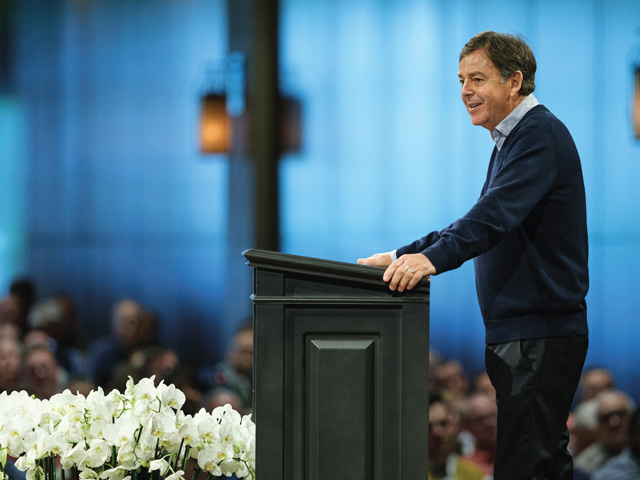
| Does your faith sometimes falter in trying times? You’re not alone! Learn from Daniel’s example, and see how his routine pattern of life directed his prayers and helped him trust God, even in his darkest days. Listen to Truth For Life with Alistair Begg. |
References
Bob Lapine: Does your faith sometimes falter in trying circumstances? I think that's the case for many of us. Today on Truth for Life, we'll learn from Daniel's example. We'll see how his routine pattern of life directed his prayers and helped him trust God, even when the days turned dark. Alistair Begg is teaching from Daniel chapter 9.
Alistair Begg: Daniel has acknowledged that the calamity that the people of God have encountered is directly related to their sin. Verse 14, Therefore the Lord has kept ready the calamity and has brought it upon us, for the Lord our God is righteous in all the works that he has done. And we have not obeyed his voice. And now, oh Lord our God, who brought your people out of the land of Egypt with a mighty hand, and have made a name for yourself as at this day, we have sinned, we have done wickedly. Oh Lord, according to all your righteous acts, let your anger and your wrath turn away from your city Jerusalem, your holy hill, because for our sins and for the iniquities of our fathers, Jerusalem and your people have become a byword among all who are around us. Now therefore, oh our God, listen to the prayer of your servant and to his please for mercy and for your own sake, oh Lord, make your face to shine upon your sanctuary, which is desolate. Oh my God, incline your ear and hear, open your eyes and see our desolations and the city that is called by your name. For we do not present our pleas before you because of our righteousness, but because of your great mercy. Oh Lord, hear. Oh Lord, forgive. Oh Lord, pay attention and act, delay not for your own sake, oh my God, because your city and your people are called by your name. While I was speaking and praying, confessing my sin and the sin of my people Israel, and presented my plea before the Lord my God for the holy hill of my God, while I was speaking in prayer, the man Gabriel, whom I'd seen in the vision at the first, came to me in swift flight at the time of the evening sacrifice. He made me understand, speaking with me and saying, Oh Daniel, I have now come out to give you insight and understanding. At the beginning of your please for mercy, a word went out, and I have come to tell it to you, for you are greatly loved. Therefore, consider the word and understand the vision. 70 weeks are decreed about your people and your holy city to finish the transgression, to put an end to sin, and to atone for iniquity, to bring in everlasting righteousness, to seal both vision and prophet, and to anoint a most holy place. Know therefore and understand that from the going out of the word to restore and build Jerusalem, to the coming of anointed one, a prince, there shall be seven weeks. Then for 62 weeks it shall be built again with squares and moat, but in a troubled time. And after the 62 weeks an anointed one shall be cut off and shall have nothing, and the people of the prince who is to come shall destroy the city and the sanctuary, its end shall come with a flood and to the end there shall be war, desolations are decreed. And he shall make a strong covenant with many for one week, and for half of the week he shall put an end to sacrifice and offering, and on the wing of abomination shall come one who makes desolate until the decreed end is poured out on the desolator. This is the word of the Lord. Thanks be to God. Let's try that again. Yes, okay, one is good, and two is better. This is the word of the Lord. Thanks be to God. Gracious God, we turn to the word, but we turn first to you, the Lord of the word. Asking earnestly, humbly that we might know the enabling of the Holy Spirit, that the pages of our Bibles may be illumined to us. That our hearts may be softened before its truth, that our wills might be brought into line with its truth. Show us ourselves, show us our Savior, we pray. In Christ's name. Amen. Well, here we are, back to our studies in Daniel. Chapter 9 contains the most difficult passage in the entire book of Daniel. In fact, having spent a long time on it, maybe the most difficult passage in the entire Bible. It's up for question. We need to move quite quickly through a large section of the text that will take us probably right to verse 19. This demands that I need to be selective in part. My assumption is always that you are reading the Bible, that you're reading before, during and after, and that you have access to material that will help to supplement that which we learn together on the Lord's Day. Without that, I think it's virtually impossible for any of us to really come to terms with the text of scripture. The idea that one little dip into the Bible for 30 or 35 minutes once a week will be able to teach us the overarching themes of the Bible and an understanding of it is really a forlorn hope. And so, I say that just as a word of reminder and perhaps as a word of encouragement. This is one of the great prayers of the Bible of the Old Testament and the key in Daniel itself. We know that Daniel prayed. Prayer for Daniel was not a spasmodic activity, it wasn't a passing fancy. We saw in chapter 6 that it was the result of his unwillingness to submit to the overreaching of the state that found him in the lion's den. And in that chapter, we're reminded of the fact that Daniel, despite what the government was saying, still prayed in his room three times a day. And in the NIV it makes that point by using the word still prayed, as if somehow another he just began to do it because he was a subversive character, is not true at all. He was what he was and prayer was at the very heart of his life. Therefore, it's no surprise that as this book unfolds, we find him here in the first year of Darius, the son of Ahasuerus, which incidentally puts it as a parallel to what we've just referred to in chapter 6. And essentially what we discover as the chapter opens is that Daniel was having his quiet time, if we can put it that way, that he was both reading the Bible and he was praying. This was part of the pattern of his life. Daniel knew that the word of God was a lamp to his feet and a light to his path. And here, as would be true for other periods of his life, he was paying attention to what the prophets of God had said. I'm not going to do a lot of this, but you will be helped if you turn just to this one section of Jeremiah chapter 25, so that you can, we can understand together what it was that stirred him to pray. Jeremiah chapter 25 has to do with the exile, with the captivity of the people of God, Daniel is in the midst of this. The people of God are wondering how long this is going to go on. Daniel is reading in the books of the words, and if we just read from verse 11, let's say, 25:11, the word of God through the prophet, this whole land shall become a ruin and a waste, and these nations shall serve the king of Babylon 70 years. Then after 70 years are completed, I will punish the king of Babylon and that nation, and so on. And so Daniel's reading and he realizes that the time of the exile is about to draw to a close. And since God was the one responsible for the beginning of the exile, so God will be responsible for the end of the exile. You remember back in chapter 1, we noted that God gave the people into the hands of the marauding forces of the Babylonians. God was responsible for his people being in this predicament, and God would relieve his people from this predicament in due course. Incidentally, the cry, how long will this go on, the feeling of how hard is it to sing the song of the Lord surrounded by such oppression and so many alien ideas is not a cry that is anchored in the 6th century BC, but is a recurring cry of the people of God throughout the periods of history and indeed throughout the geography of the world. And some of you actually, I know from listening to you, have this question as a recurring notion in your heart and mind, because you will often voice it when I'm in your company. How long is this going to go on like this? How long is it going to be where the forces of oppression seem so amazingly powerful and the people of God seem so incredibly weak and useless? Well, Daniel read his Bible. And as he read the Bible, although he was a man who had been given insight into visions and who could understand things, he was humble enough to listen to the word of the prophet and to pay attention. And as a result of that, he was then stirred to pray. Let me just make one point here before we move on, and that is concerning a daily dose of the Bible, if you like. Without a daily diet of the word of God, we will find ourselves living in immaturity. We will find ourselves living in immaturity. I've mentioned it already, and I want to say to you again that it is both foolish and it is dangerous, and it will stunt your spiritual growth if the Bible is not for you on a routine basis, the lamp and the direction of your life. Those who have been most useful in the kingdom of God have never deviated from this pattern. And when we're tempted to do so, I think each of us would confess to the distinction that we then face. John Stott, who has been, who was in his life a classic example of Christian godliness, says of the importance of time alone with God, one of the great purposes of daily Bible reading and prayer is to get ourselves correctly oriented, to remember who and what we are. And when we turn to the Bible on a daily basis, despite everything that is going on around us, we read in the scriptures, and the Spirit of God brings home to us the things that are true, that are verities, that transcend time and they transcend geography as well, and the various machinations of the political forces around us. It is a striking thing to me in reading this, that an understanding of God's purpose, which he's given, and a trust in God's promise. does not then lead Daniel to say, well, there's nothing I need to do. He reads Jeremiah, and he reads that the exile is going to come to an end after 70 years. But he doesn't say, well, in that case, we can just relax and wait it out. No, it is the discovery of that which leads to his prayer. If you look, for example, at verse 16. here is his cry out to God. Oh Lord, according to all your righteous acts, let your anger and your wrath turn away from your city Jerusalem, your holy hill. Well, but he said, he just read in Jeremiah that that's exactly what God is going to do. So why is he asking him to do what he's going to do? Because somehow in the economy of God, the prayers of God's people are interwoven in the unfolding of God's purpose. Now you can think that out. You're a sensible group. Essentially what he's saying is Father, may your will be done on earth. Now, with that as the setting, let's consider just very briefly, first of all, his approach, the approach that he takes. And you will see it there in verse 3. Then I turned my face to the Lord God. In other words, there's nothing casual, nothing trivial, nothing banal, rather, it is deliberate. I turned my face, or in some translations, I set my face. One of the, one of the challenges for young parents, and particularly young moms, I think they bear the brunt of it, is to make sure that their children look at people when they're talking to them. Isn't that what the young mom say? Look at me when you're talking to me. I don't be looking out the window, look at me, you're talking to me. And of course, it is a strange and usually an unsettling kind of thing when somebody who is apparently talking to you is looking beyond you and is talking away to you. It's like, am I here or what's going on? The picture is very clear. He's not talking to God while working on his laptop, he's not talking in some strange way. No, he's very deliberately setting his face to the Lord, turning to him, seeking him, pleading with him, fasting and assessing him. He knows the words of the psalmist, You have said, seek my face. My heart says to you, your face I will seek. That's his approach. I sought the Lord, and he answered me and delivered me from all my fears. We could say more, but we must move on. I have a series of A's this morning. First of all then, his approach is a very deliberate, humble, purposeful approach. Notice secondly how he addresses God, how he addresses God. I prayed to the Lord my God and made confession saying, Oh Lord, the great and awesome God. In other words, he addresses God as God. You say, well, that's, you know, that's a brilliant insight. I wouldn't say it's brilliant, but I would think it's necessary. Because we don't always address God as God. In our prayers, both private and public, if people could hear us, they would say, are you really going to address the creator of the universe in such a casual and trivial manner? Who do you think you are? When Isaiah saw the Lord in Isaiah 6, high and lifted up. Remember what he said? I'm a man of unclean lips. Somebody else would have said, no, wait a minute, you're the prophet of God. Yes, he was. And I live in the middle of a group of people who also have unclean lips. Well, that's not very nice to say about people. What was it that brought this out of him? When he addressed God, he understood to whom he was speaking. God is great, God is awesome, God is holy, God is majestic, God is not like us. And his majesty is no barrier to intimacy with him. But we ought never to assume that intimacy is expressed with some kind of undue informality and easiness. I know that some of you think that I just bring a bunch of little shibboleths from Scotland and, you know, I'm growing increasingly old and and cold and settle in my ways and disgruntle and so on. And that may all be true. But there is actually a reason why I talk about silence in the moments before we are led in praise and turn to the word. There is a reason. Because we're not at the Rotary Club. We haven't met each other at Starbucks. We're not on a trip. This place is not a sanctuary. But when we gather as the people of God corporately to engage with God, we are in a place and in a time that is unlike other times. And so when we have listened to the word of God, the idea of sitting and being silent for a nano second, let alone time for the word of God to settle in our hearts. The reason for that in my mind is all related to the way in which we come before the covenant-keeping God. And when people come into a place of praise and worship and come into the study of the word. They can tell how serious that congregation is about what is happening in the preaching of the word, in the praising of God's name. The visitor can understand. And therefore we have a responsibility not only in terms of looking to God, but in encouraging one another and in letting those who come in and say, wow, what is this about? I thought it would be a lot more cozy, I thought it would be a lot more jazzy. I thought, what's, what's with the silence? Oh God, you are the great and awesome God. You keep your covenant love with those who obey your commandments. You see, that's the nature of covenant love. God has entered into a covenant with his people. He's told them through Moses, I will be your God and you will be my people. This is how it's going to work. You do what I tell you. I'm going to give you my commands and my rules. You do that, we're going to live together very happily. You disobey that, you're going to be in all kinds of mess. You see, because love without obedience is just sentimentality. And when you think about the gathering of God's people and the nature of praise and the significance of prayer and all of these things. This catches us off guard, doesn't it? Because it confronts us with the fact that we are so influenced by the culture around us, we are so influenced by the mindset of a generation that looks to itself as the be all and end all of what's taking place. And never actually gets to the place where it says, oh Lord, you are the great and awesome God, and we might want to think about that for just a moment, that you are holy, that you are righteous, and we are not. That's his approach. And then thirdly, his admission. It's really his confession, but I wanted to keep it with A's. So, his confession, where does he go from this? You are the great and awesome God. Verse 5, We have sinned and done wrong and acted wickedly and rebelled and turned aside from your commands and rules, we have not listened to your servants, the prophets and so on. Now notice that Daniel's relationship here with God is both personal and communal. He's referred to him as my Lord, my God. I prayed to the Lord my God, verse 4. Now in verse 5, we have sinned. It's just a simple reminder of the fact that we're brought into God's family, and in that family we have responsibilities to each other and we share with one another. He wasn't casual in his approach, neither is he vague in his admission of guilt. We've done wrong, we've acted wickedly, we're we're guilty, we've rebelled. We say this is not a very nice way to begin the day, is it? Being reminded of this? Well, think about it, most of us don't want to be reminded of this. Most of us want to pretend, we want to have a just a sort of brief, a brief passing thought about the fact that yeah, well, yeah, I'm a sinner. Yes, let's get on now. No, but I'm rebellious. I see what God's word says and I want to rebel against it. I see that the path of righteousness is a narrow road that leads down here, and I fancy going on the wide street. I know that God's word is there in order that I might hear it, but I don't want to listen to it. I'm wicked. I'm rebellious.
Bob Lapine: You're listening to Truth for Life with Alistair Begg. We'll hear more about Daniel's prayer tomorrow. You know, to be able to pray and trust God's promises as Daniel did, it's important to spend time getting to know God through his word. If you'd like to be rooted in God's word, but you're unsure where to begin, you can study along with Alistair every day when you sign up for Truth for Life's daily devotional email. Start each morning by reading a passage from scripture, followed by a brief commentary from Alistair, then consider how to live out the instruction as you go about your day. The daily devotional is a free subscription, and you can sign up at truthforlife.org/lists. There's also an audio version of the daily devotions. You can listen to them on our website or our mobile app. Subscribe to them through popular podcast platforms like Apple or Spotify, YouTube or Amazon. Simply search for Truth for Life daily devotions and choose the subscribe option. And if you prefer a hardback book that you can highlight or make notes in, you can purchase Alistair's devotional book, Truth for Life, 365 Daily Devotions in our online store. There are two volumes. Each hard cover volume is available at our cost of just $8 at truthforlife.org/store or give us a call at 888-588-7884 to place your order. I'm Bob Lapine. Thanks for studying God's word with us. The Bible makes it clear that as Christians, we're not perfect. By nature, we're sinners like everyone else. So what does distinguish us from the rest of the world? Tune in tomorrow to hear the answer. The Bible teaching of Alistair Begg is furnished by Truth for Life. Where the learning is for living.
Related Episodes
Daniel’s Prayer (Part 2 of 2)
Thursday, July 30
“Your Will Be Done” (Part 3 of 3)
Tuesday, July 28
“Your Will Be Done” (Part 2 of 3)
Monday, July 27
About Truth For Life
Truth For Life distributes the unique, expositional Bible teaching of Alistair Begg. Studying God’s Word each day, verse by verse, is the hallmark of this ministry. In a desire to share the good news of the Gospel without cost as a barrier, the entire teaching archive is available for free download and resources are available at cost with no markup.
About Alistair Begg
Alistair Begg has been in pastoral ministry since 1975. Following graduation from The London School of Theology, he served eight years in Scotland at both Charlotte Chapel in Edinburgh and Hamilton Baptist Church. In 1983, he became the senior pastor at Parkside Church near Cleveland, Ohio. He has written several books and is heard daily and weekly on the radio program, Truth For Life. The teaching on Truth For Life stems from the week by week Bible teaching at Parkside Church. He and his wife, Susan, were married in 1975 and they have three grown children.Contact Truth For Life with Alistair Begg
Website
http://www.truthforlife.org/?utm_source=oneplace&utm_medium=sitelinks&utm_campaign=home
Mailing Address
Truth For Life
P.O. Box 398000
Cleveland OH 44139
Telephone (Customer Service)
888-588-7884 Domestic
400-543-6800 International
440-543-0522 ( Fax)


